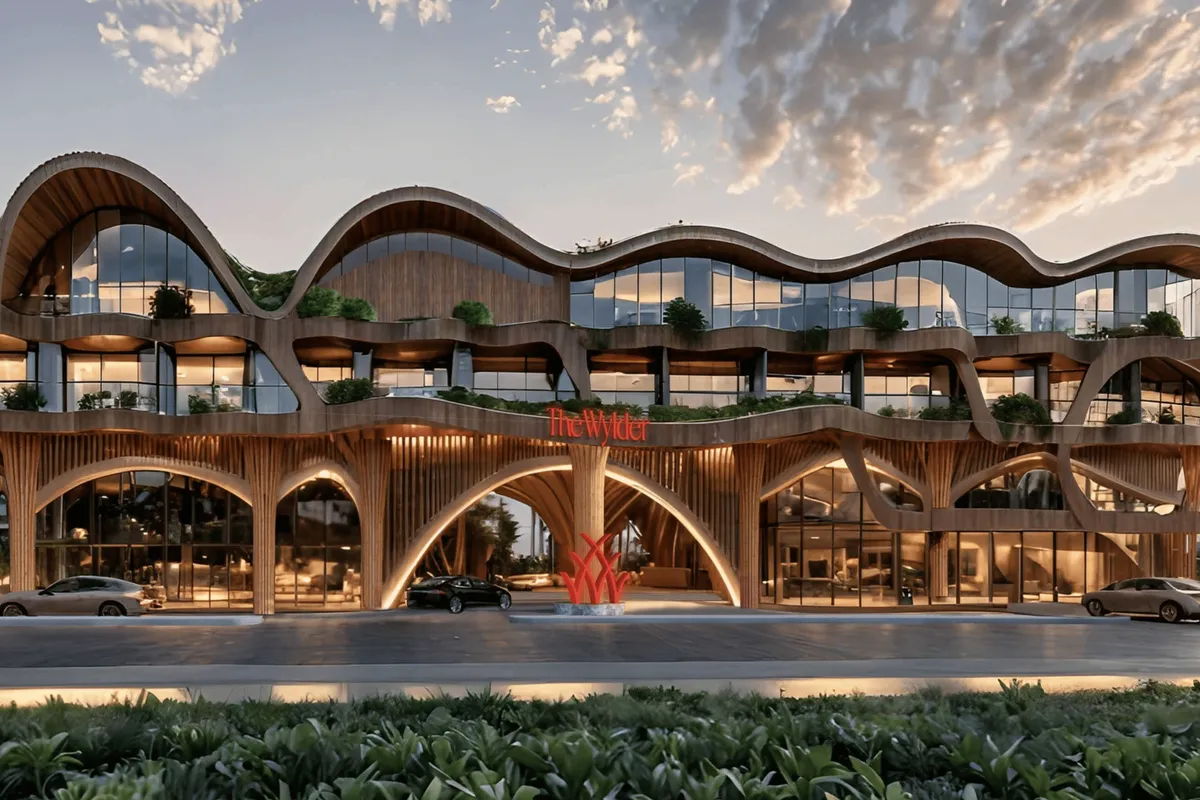
How Are the Projected Returns Calculated for The Wylder Hotel in Bali?
Understanding how fractional hotel investment income is generated, calculated and distributed.
One of the most common questions we hear from Australians considering an investment in The Wylder Hotel in Berawa, Canggu, is:
"How are the projected returns actually calculated?"
It's a great question. And one every investor should be asking before committing their money.
When you see projected investment returns of around 15% per annum from a luxury Bali hotel, it's natural to wonder where those numbers come from.
Are they based on occupancy? Room rates? Restaurant revenue? Are they guaranteed? And what happens if the hotel doesn't perform as expected?
Let's break it down.
First, understand what you're actually investing in
The Wylder isn't a traditional villa investment where you purchase a property and rely on rental bookings to generate income.
Instead, investors purchase a fractional leasehold interest in a professionally managed lifestyle hotel in Berawa, Canggu.
Each hotel room is divided into 20 fractions, with each fraction representing a 5% leasehold interest in that accommodation unit, together with proportional participation in the wider resort facilities.
The development is being delivered by PT Geonet Developments International and will be operated by SONO Hotels & Resorts, with opening currently targeted for 2029.
The important distinction?
Your investment income is designed to come from the performance of the resort's broader hospitality business, not simply the occupancy of one individual hotel room.
1. How is the resort's projected revenue calculated?
The starting point is the hotel's financial operating model.
For accommodation, the calculation considers three important variables:
Average Daily Rate (ADR): The average nightly price guests are expected to pay.
Occupancy: The percentage of available rooms expected to be occupied.
Available room nights: The number of rooms multiplied by the number of nights available for sale.
For example, imagine a hypothetical 100-room hotel achieving an average nightly rate of AUD $250 and annual occupancy of 75%.
Its estimated annual room revenue would be:
100 rooms × 365 nights × 75% occupancy × $250
= AUD $6,843,750 in annual gross accommodation revenue.
*This is an illustration of how hotel revenue is calculated, not The Wylder's actual forecast.
But accommodation is only one part of the equation.
2. The Wylder is designed to earn revenue beyond hotel rooms
This is where the investment model becomes particularly interesting.
The Wylder is being developed as a lifestyle destination, with facilities designed to attract both hotel guests and visitors who aren't staying overnight.
Its amenities include a lagoon pool, rooftop restaurant and bar, speakeasy lounge, cinema, wellness and recovery facilities, spa, café, coworking spaces and other hospitality experiences.
These businesses create additional potential revenue streams.
For example, a guest might stay in the hotel for three nights, but also spend money on dining, cocktails, wellness treatments and entertainment.
Meanwhile, someone staying elsewhere in Canggu might visit the rooftop bar or restaurant.
That means the resort can earn revenue from customers who never book a room.
The Wylder income profile indicates that accommodation represents approximately one-quarter of the resort's projected total revenue, with the wider hospitality operation expected to generate the balance.
That diversification is an important part of the financial model, although it also means actual returns depend on the profitability of several different businesses.
3. How does resort revenue become investor income?
The Wylder's income-sharing model has two components.
Accommodation revenue
Under the income profile, 45% of net room income is allocated to the investor income pool.
For this purpose, net room income is defined as gross room revenue less a 5% sinking fund.
The sinking fund provides an allowance associated with the upkeep and future requirements of the accommodation assets.
Resort facilities and hospitality revenue
Investors also participate in 75% of the net profit before tax generated by the resort's facilities.
This includes the wider hospitality businesses such as restaurants, bars, wellness, spa and entertainment.
It's important to understand the difference between revenue and profit.
A restaurant might generate $1 million in sales, but that doesn't mean $1 million is available to distribute. Operating expenses must first be deducted to determine the relevant profit.
The two income components are then combined into the investor income pool.
Distributions are allocated according to the value-weighted participation of each investment holding.
In simple terms: the more investment value you hold, the larger your proportional participation in the income pool.
This is why investors can participate in the performance of the wider hotel rather than relying exclusively on the bookings of their particular room.
4. What about the 8% and 10% income during construction?
Another important distinction is that The Wylder's investment structure has different income arrangements at different stages.
During construction — targeted FY2026 to FY2028
An 8% annual construction cash rebate on advance consideration is paid across 36 months.
Or it's 10% for investments of AUD $250,000 or more.
The construction rebate is structured as a reduction in the net lease price, rather than income generated by hotel operations.
This distinction matters when calculating the investment's effective cost and returns and taxation.
During the first two years of hotel operations — FY2029 and FY2030
The model has minimum lease income floors of:
8% per annum for investments below AUD $250,000.
10% per annum for qualifying investments of AUD $250,000 and above.
The income floor is compared with modelled operating income, with the higher amount paid out to investors above the floor if operational actuals are higher.
From the third year of operations — FY2031 onward
The minimum income floor no longer applies.
Investor distributions are then determined by the resort's actual financial performance and the applicable income-sharing structure.
This is where the longer-term projected returns become relevant.
5. So where does the projected 15% annual return come from?
The projected return is derived from financial modelling of the resort's anticipated future trading performance.
The model considers expected accommodation revenue, the financial contribution of the wider hospitality facilities, the investor revenue-sharing arrangements and the purchase price of each fractional interest.
Projected distributions can then be expressed as a percentage of the amount invested.
For example, if an investor purchases a fractional interest for AUD $100,000 and receives AUD $15,000 in annual distributions, the annual cash yield would be:
$15,000 ÷ $100,000 × 100 = 15% per annum.
However, this is an illustrative calculation, not a promise that The Wylder will deliver $15,000 on a $100,000 investment.
The published Wylder income profile includes low, expected and high scenarios over a ten-year modelling horizon.
The actual projected percentage needs to be read against the relevant scenario, investment period and purchase-price basis. The profile does not promise that 15% will be earned every year from the third year of operations.
6. What happens if the hotel doesn't achieve its projected occupancy or revenue?
This is one of the most important questions investors should ask.
Hotel financial models are built on assumptions, and actual performance can differ.
Lower occupancy, weaker nightly rates, higher operating costs or lower-than-expected restaurant and hospitality profits could all reduce the amount available for investor distributions.
Conversely, stronger performance could potentially increase distributions.
From the third year of operations, investors participate in actual resort performance rather than receiving a fixed annual return.
The projected return is therefore a financial scenario, not a guaranteed outcome.
Investors should also understand development risk, operator performance, contractual obligations, liquidity, currency exposure and the implications of holding a long-term leasehold interest rather than owning freehold land.
7. How long does it take to recover your initial investment?
Another useful measure is capital recovery.
This is the point at which the total distributions received equal the original amount invested.
For example, an investor who contributes AUD $100,000 and receives cumulative distributions totaling AUD $100,000 over a number of years has achieved cash-flow capital recovery.
The Wylder financial model includes an expected-case capital recovery calculation, but the actual timeframe will depend on distributions achieved and the applicable investment terms.
8. What should investors ask before relying on projected returns?
Before investing in any Bali hotel or resort, it's worth understanding:
What assumptions have been made about occupancy, room rates and hospitality revenue?
Which operating expenses are deducted before investor distributions?
How is the investor income pool calculated and allocated?
What contractual obligations support the minimum income floor?
What happens if construction is delayed or the resort underperforms?
How do the low, expected and high financial scenarios compare?
What are the leasehold terms and options for exiting the investment?
A credible investment decision should be based on understanding the financial model, the contractual structure and the risks — not simply choosing the project advertising the highest percentage return.
The bottom line: Understand the business behind the returns
What makes The Wylder an interesting investment proposition isn't just its projected percentage return.
It's the opportunity to participate in a professionally operated hospitality destination with multiple potential sources of income.
Rather than relying on one villa, one booking calendar or one accommodation unit, investors participate in a broader resort business.
The smartest question isn't simply "What return can I earn?"
It's "What needs to happen for this investment to deliver that return?"
And that's exactly the conversation we encourage every investor to have.
Want to understand The Wylder's projected returns in more detail?
I'm Sarah-Jane Picton-King, founder of Bali Property Investment, and I personally hold four investments in Bali.
I help Australians understand the opportunities, structures and risks involved in investing in Bali hotels and resorts.
If you'd like to explore The Wylder, understand how its fractional ownership model works or discuss the financial projections, I'd be happy to answer your questions.
Disclaimer: This article provides general information only and is not personal financial advice. Projected investment returns are not guaranteed. Construction rebates, minimum income arrangements and operating distributions are subject to the relevant contractual documents. Investors should review the applicable disclosure documents and seek independent legal, tax and financial advice before investing.


